
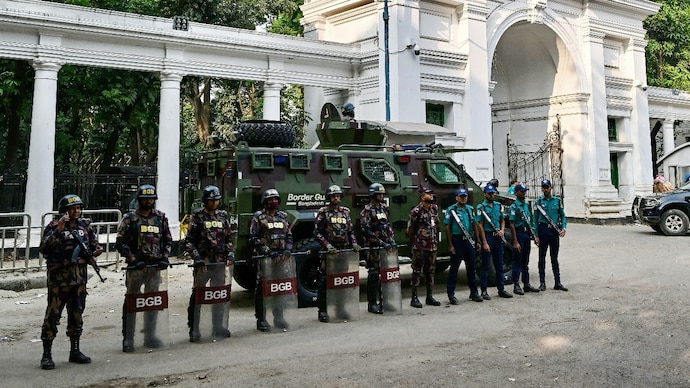
Bangladesh’s capital, Dhaka, witnessed a new wave of violence and bomb attacks this week as tensions flared following a major verdict by the International Crimes Tribunal (ICT) against deposed Prime Minister Sheikh Hasina. The city, home to more than 20 million people, turned into a fortress as police and paramilitary forces were deployed to control protests, clashes, and rising unrest in several parts of the country.
The situation marks yet another chapter in Bangladesh’s cycle of political turbulence — a struggle that mixes deep-rooted party rivalries, street power politics, and anger over economic hardship.
What triggered the violence?
The immediate spark for the violence came after the International Crimes Tribunal delivered its judgment against Sheikh Hasina, the former Prime Minister and head of the Awami League. Hasina, who ruled Bangladesh for nearly 15 years, was removed from power earlier this year following months of protests against her government over allegations of corruption, suppression of opposition, and manipulation of the electoral process.
The tribunal found her guilty on multiple charges related to abuse of power and misuse of state resources. While her supporters claim the charges are politically motivated, opposition groups have hailed the verdict as a “victory for justice.”
However, the court’s decision quickly triggered large-scale unrest. Pro-Hasina supporters took to the streets in several areas, alleging political persecution, while opposition activists used the moment to stage protests of their own.
Within hours of the verdict, reports emerged of small explosions, crude bomb attacks, and clashes between rival groups in Dhaka and nearby towns.
healthboostfit.com | silkesell.com | maps-long-island.com
HostingPerTutti.com | finvestguide.com
Dhaka turns into a fortress
The scale of the violence forced the government to take immediate measures. Security forces imposed strict restrictions on movement across central Dhaka. Key government buildings, foreign embassies, and transportation hubs were heavily guarded.
All entry and exit routes to Motijheel, Dhanmondi, Mirpur, and Shahbagh were blocked. The Rapid Action Battalion (RAB), Bangladesh’s elite security force, carried out raids and detained several individuals suspected of planning coordinated attacks.
Eyewitnesses reported hearing multiple explosions near the court area and bus terminals, believed to be crude bombs thrown by unknown attackers. Although the authorities have not confirmed the total number of casualties, local hospitals reported dozens of injuries.
Political blame game begins
As expected, the violence quickly turned into a political blame game.
The Awami League, Hasina’s party, accused opposition groups, mainly the Bangladesh Nationalist Party (BNP) and Jamaat-e-Islami, of using the verdict to destabilize the country. Awami League spokespersons called it a “planned conspiracy” to incite fear and undermine law enforcement.
On the other hand, the BNP rejected these allegations, saying the unrest was the result of years of anger and frustration among ordinary citizens who were “denied democracy and justice” under Hasina’s rule.
BNP leader Mirza Fakhrul Islam Alamgir stated, “People have suffered too long under a regime that silenced every voice of dissent. What you see on the streets today is the reflection of years of repression.”
Why are people so angry?
While the verdict acted as a trigger, the underlying causes of the unrest run much deeper. Bangladesh is currently facing a severe economic crisis, marked by rising food prices, a weakening currency, and increasing unemployment among youth.
Public frustration has been building for months. Frequent power cuts, declining export earnings, and the government’s tough stance on dissent have created an environment of deep distrust.
Many citizens also feel disillusioned with both major political parties — the Awami League and the BNP — which have dominated the country’s politics for decades but failed to bring lasting stability.
“Ordinary people are tired,” said political analyst Mahfuz Rahman. “They see the same cycle repeating — protests, blame, crackdowns, and no real change.”
History of political violence in Bangladesh
Bangladesh has a long history of street politics and violent protests. Since its independence in 1971, the nation has experienced coups, assassinations, and mass movements.
In 2013 and 2014, similar scenes unfolded when the International Crimes Tribunal sentenced several Jamaat-e-Islami leaders for war crimes committed during the 1971 liberation war. Back then, Dhaka also saw bombings, arson attacks, and police clashes that left hundreds dead.
Political violence often spikes during transition periods — when governments fall, or elections approach. Each side accuses the other of undermining democracy, while the people bear the brunt of the chaos.
International reactions
The recent unrest has caught the attention of the international community.
The United Nations and several foreign embassies in Dhaka have urged restraint and dialogue. The US State Department issued a statement saying it was “deeply concerned” about the growing violence and called for “transparent and fair political processes.”
India, Bangladesh’s closest neighbor and long-time ally, is closely monitoring the situation. The Indian Ministry of External Affairs said it hopes for “peace and stability in Bangladesh” and emphasized the importance of “upholding democratic institutions.”
What happens next?
For now, the government has deployed additional troops to maintain peace in Dhaka and key districts. Intelligence agencies are working to track down those behind the bomb attacks.
Political observers believe the coming days will be critical. If protests continue, the government may impose emergency measures, such as curfews or internet restrictions, similar to what happened during the 2018 unrest.
Analysts warn that continued instability could hurt Bangladesh’s economy, especially its vital garment export industry, which employs millions and contributes heavily to the nation’s GDP.
The next few weeks will test whether Bangladesh’s leadership can find a way to calm tensions and restore confidence — or if the country will once again fall into the familiar pattern of political chaos.
A country at crossroads
Bangladesh today stands at a crossroads. The anger on the streets is not just about one verdict or one leader — it reflects decades of frustration, inequality, and unfulfilled promises.
While political rivalries continue to dominate headlines, the real issue remains trust in governance and institutions. Many citizens hope that this crisis will serve as a wake-up call for leaders across party lines to focus on rebuilding that trust, instead of tearing each other down.
Until that happens, the streets of Dhaka may continue to echo with unrest, as Bangladesh struggles to balance democracy, justice, and peace.