
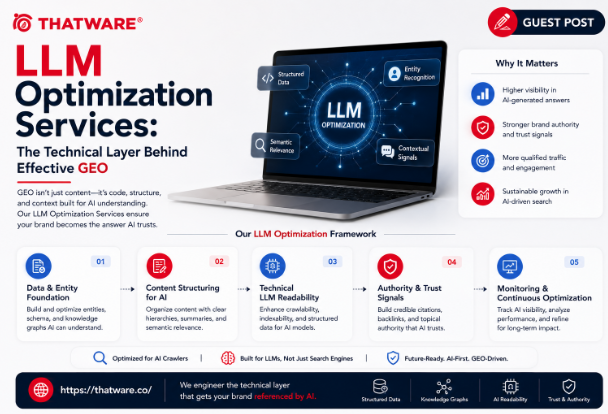
There’s a quiet shift happening in how businesses think about search visibility — and if you’re still only focused on traditional SEO, you might already be falling behind. Not because SEO is dead (it isn’t), but because the landscape has grown a layer more complex. Large language models are now mediating how people find information, and that changes everything about what “ranking” actually means.
Let’s talk about that layer. The one that most content teams haven’t fully wrapped their heads around yet.
When Search Stopped Being Just About Links
For a long time, the game was fairly legible. You wrote content, built backlinks, optimized your meta tags, and hoped Google’s crawlers smiled on you. There was something almost mechanical about it — like learning the rules of a board game and playing accordingly.
Then came generative AI. Tools like ChatGPT, Perplexity, Google’s AI Overviews, and Bing Copilot started answering questions directly. Users stopped clicking ten blue links and started trusting summarized responses. And suddenly, being “optimized” meant something fundamentally different. It meant being cited by a model. Being understood by one. Being the source a language model reaches for when someone asks a question in your niche.
That’s the terrain of Generative Engine Optimization — GEO — and it’s messier and more nuanced than what came before it.
What LLMs Actually Do With Your Content
Here’s something worth sitting with for a moment: large language models don’t index your page the way a crawler does. They don’t follow links and log URLs. They’re trained on enormous datasets, and they develop a kind of probabilistic understanding of topics, entities, and relationships. When someone asks a question, the model retrieves — or generates — a response based on patterns baked into its weights.
What this means practically is that how your content is structured, how clearly it articulates relationships between concepts, and how authoritative it appears in context — these things matter enormously. A page stuffed with keywords but thin on substance? A model won’t learn much from it. A well-organized, entity-rich piece of content that consistently addresses real questions in a given domain? That’s the kind of material that shapes model understanding.
This is where LLM optimization services come in — not as a shiny buzzword repackaging, but as a genuinely distinct technical discipline. Getting your content to perform in an LLM-mediated environment requires different tools, different audits, and a different philosophy about what “good content” means.
The Technical Stuff People Gloss Over
Most articles about GEO stay at the surface. “Write clearly.” “Use structured data.” “Build E-E-A-T.” All true, all useful — but none of it tells you what’s actually happening under the hood.
Entity recognition is a big piece of this. LLMs parse content in terms of named entities — people, organizations, concepts, locations — and the relationships between them. If your content introduces a topic but doesn’t build a coherent entity graph around it, the model has less to work with. It might understand what you’re about, but not why you’re authoritative about it.
Then there’s the question of how LLMs handle ambiguity. If your content could be about multiple things — or if it uses industry jargon without sufficient grounding context — models may assign lower confidence to your content as a source. Clarity isn’t just a reader experience issue; it’s a model comprehension issue.
There’s also the matter of citation patterns. Some researchers studying LLM behavior have found that content which follows certain structural conventions — clear definitions, explicit attributions, numbered or enumerated claims — is more likely to be surfaced as a reference. Whether this is by design or emergent behavior isn’t always clear. But it’s consistent enough to design around.
GEO Isn’t Just About Being “AI-Friendly”
One thing I want to push back on slightly is the framing that GEO is about making your content palatable to AI systems. That’s a bit reductive. The deeper goal is establishing topical authority in a way that’s legible across both human readers and automated systems — including the LLMs that are increasingly shaping what users see first.
AI-powered search optimization services that actually work don’t just run your content through a checklist. They audit your site’s semantic architecture. They look at how your internal linking reflects topical clusters. They assess whether your brand entity is consistently described and cross-referenced across the web. They consider schema markup not just as a technical nicety but as a way of communicating structured knowledge to systems that process language at scale.
It’s genuinely technical work. Not glamorous, not the kind of thing you can explain in a tweet — but it makes a real difference in whether an AI-powered search surface cites your content or your competitor’s.
The Disconnect Between Traditional SEO and LLM Readiness
Here’s a tension that comes up often in this space: sites with strong traditional SEO signals — high domain authority, lots of backlinks, solid Core Web Vitals — sometimes underperform in AI-generated responses compared to what you’d expect. And newer, leaner sites occasionally punch above their weight.
Why? Because LLMs don’t weight authority the same way PageRank does. A site with hundreds of thin, keyword-targeted pages may have accumulated link equity over the years, but if those pages don’t contribute coherent, specific knowledge about a topic, they don’t add much to the model’s understanding of the domain.
Contrast that with a site that has fifty genuinely detailed, well-structured pieces that systematically cover a subject area — connecting concepts, referencing primary sources, defining terms precisely. That site might rank lower on a traditional SERP, but it’s the kind of source a language model learns from. And increasingly, that’s the game.
This is a bit uncomfortable for established players. But it’s also an opening for brands willing to invest in content quality and technical optimization at the semantic level.
What Getting This Right Actually Looks Like
The practical implementation varies by site, by industry, by how mature your existing content library is. But some things show up consistently in GEO work that’s done well.
Semantic consistency matters — using the same terminology across a site to describe the same concept, rather than varying it for “variety.” Models learn from patterns, and inconsistent nomenclature creates noise. So does the absence of clear definitions for terms that matter in your domain.
Structured data — particularly schema types like Article, FAQPage, HowTo, and Organization — helps models parse not just what your content says, but what kind of content it is and what entity it belongs to. This isn’t just for Google’s rich results anymore; it’s genuinely useful context for any system processing your pages.
And then there’s something harder to systematize: the depth and specificity of claims. Content that asserts things without support, or covers topics at a level of abstraction that never gets specific, tends to be treated as lower-confidence by systems that are aggregating knowledge. Going deeper — even on narrow questions — tends to pay off.
Where This Is Heading
If you’ve been paying attention to how search interfaces are evolving, the direction is pretty clear. AI answers are becoming more common, more trusted, and more the default entry point for information. The question of who gets cited, who gets surfaced, who gets trusted by these systems is becoming as commercially important as any traditional SEO metric.
That doesn’t mean ignoring conventional optimization — backlinks still matter, technical performance still matters, user experience still matters. But layered on top of all of that is a new technical discipline that sits at the intersection of content strategy, knowledge graph management, and LLM behavior analysis.
Companies that treat this as a real capability, and invest in developing it, are going to have a meaningful edge as AI search continues to mature. The ones that assume their existing SEO foundation will carry them through probably won’t fare as well.
The rules haven’t changed entirely. But a new layer has been added. And that layer rewards precision, depth, and technical fluency in ways that the old game just didn’t demand.