
Few young cricketers in recent years have generated as much excitement as Vaibhav Sooryavanshi. The teenage batting sensation has earned widespread admiration after his remarkable performances in domestic cricket and franchise tournaments, leading to his selection in India's T20I squad for the tour of England. However, instead of celebrating his inclusion as part of a long-term development plan, every match has turned into a debate over one question: "Why hasn't Vaibhav Sooryavanshi made his debut yet?"
The conversation has dominated television discussions, social media platforms, and cricket forums. Every team announcement is followed by speculation, criticism, and demands for his immediate inclusion in the playing XI. While the enthusiasm reflects the enormous faith fans have in the youngster, it also creates unnecessary pressure on a player who is only beginning his international journey.
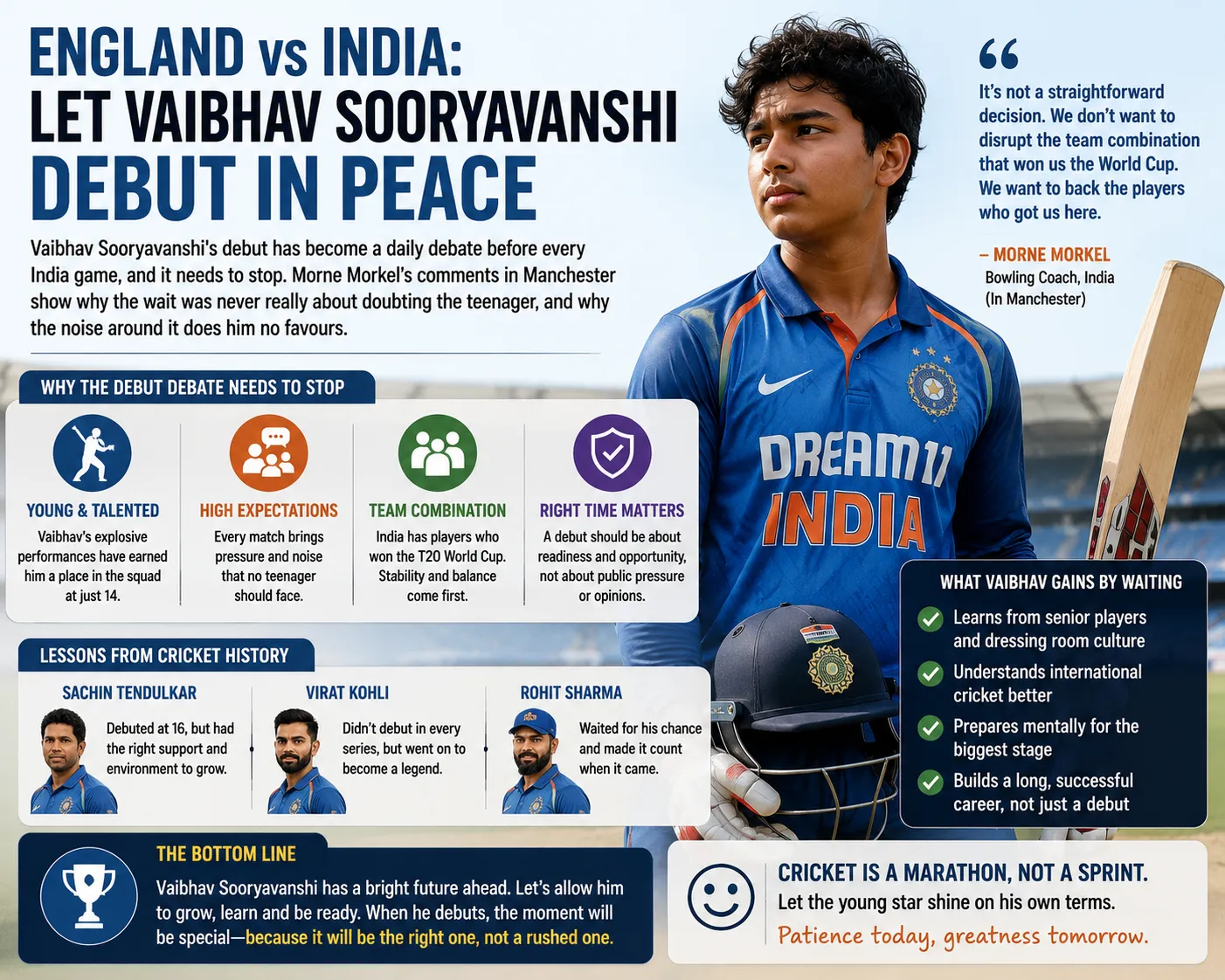
India's bowling coach Morne Morkel recently addressed the issue before the T20I in Manchester, making it clear that the management's decision was never about doubting Sooryavanshi's ability. Instead, it was about respecting the existing team combination and giving confidence to players who helped India win the T20 World Cup earlier this year. His comments offered an important reminder that player development requires patience as much as talent.
The Rise of a Teenage Sensation
Vaibhav Sooryavanshi's rise has been nothing short of extraordinary.
At an age when most teenagers are still balancing school and junior cricket, he has already established himself as one of India's brightest young batting prospects. His fearless stroke play, maturity beyond his years, and ability to dominate quality bowling attacks have attracted attention from cricket experts around the world.
His performances earned him a place in the senior Indian squad, a significant achievement that reflects the confidence selectors have in his long-term potential.
Being selected for the national team at such a young age is itself a remarkable milestone.
Why Everyone Wants Him to Debut
Whenever a highly talented youngster joins the Indian squad, expectations naturally rise.
Fans are eager to witness the next generation of stars, especially when a player has produced outstanding performances at lower levels.
Many supporters believe Sooryavanshi deserves an immediate opportunity because of his recent success and the excitement surrounding his batting.
The anticipation has only increased as every match passes without his debut.
However, international cricket often requires more than outstanding domestic performances.
Timing, team balance, opposition, conditions, and squad dynamics all influence selection decisions.
Morne Morkel's Perspective
Ahead of the England T20I in Manchester, bowling coach Morne Morkel explained why the decision was not as simple as many believed.
He emphasized that India already has established players occupying the top-order positions.
According to Morkel, it would be unfair to immediately replace players who played crucial roles during India's recent T20 World Cup triumph simply because of a few disappointing innings.
He also stressed that the management does not want to force players into unfamiliar batting positions merely to accommodate a new entrant.
The message was clear: Sooryavanshi remains highly valued, but his debut should happen when it best serves both the player and the team.
Team Selection Is More Than Individual Talent
International selection rarely depends on talent alone.
Coaches consider batting order stability, player roles, match conditions, opposition strategies, and overall team balance.
India currently possesses one of the strongest T20 batting line-ups in world cricket.
Changing multiple positions simply to introduce one promising youngster could disrupt combinations that have already delivered success.
This does not diminish Sooryavanshi's ability.
Instead, it reflects the reality that successful teams often prioritize continuity alongside individual brilliance.
The Pressure of Public Expectations
Perhaps the greatest challenge facing young athletes today is not competition on the field but constant attention away from it.
Every training session, every practice match, and every team announcement quickly becomes headline news.
Social media amplifies every opinion, creating enormous expectations before a player has even made an international appearance.
For a teenager, such attention can become overwhelming.
The pressure to justify months of public anticipation with immediate success is unrealistic for any athlete, regardless of talent.
Allowing Sooryavanshi to debut naturally rather than under constant public scrutiny may ultimately benefit his long-term development.
Lessons From Cricket History
Indian cricket has produced numerous young stars over the decades.
Some debuted very early and enjoyed legendary careers.
Others spent additional time developing before becoming international success stories.
There is no universal formula for player development.
Every cricketer follows a unique path shaped by opportunity, preparation, confidence, and experience.
The timing of a debut is only one chapter in what could become a very long career.
Far more important is ensuring that the player is mentally prepared to handle international cricket's demands.
Why Patience Matters
Modern sport often celebrates instant success.
Fans naturally want immediate results, while media coverage constantly seeks the next major story.
Yet cricket remains a game that rewards patience.
Young players require time to adjust to international travel, different playing conditions, media responsibilities, and higher competitive standards.
Learning alongside experienced teammates during training camps can be just as valuable as immediate match appearances.
The current period may therefore represent an important stage in Sooryavanshi's development rather than a missed opportunity.
The Responsibility of Fans and Media
Support from fans plays an important role in every athlete's journey.
However, excessive hype can sometimes become counterproductive.
If expectations become unrealistically high, every innings risks being judged against impossible standards.
A single failure could attract criticism equal to the praise generated before the debut.
Responsible coverage should celebrate young talent while allowing players sufficient space to learn from both success and failure.
Patience is often the greatest gift supporters can offer emerging athletes.
The Team Comes First
One principle has consistently guided successful international teams.
Individual milestones remain secondary to collective success.
Even exceptionally talented players sometimes wait for opportunities because existing combinations continue performing well.
Competition for places keeps standards high while encouraging continuous improvement.
When Sooryavanshi eventually receives his cap, it should happen because the management believes the timing is right—not because public pressure demanded immediate action.
That approach protects both the individual player and the team's long-term interests.
What Makes This Waiting Period Valuable
Remaining with the senior squad offers benefits beyond match experience.
Young players observe how established internationals prepare, recover, analyse opponents, and handle pressure.
They learn professional routines, tactical awareness, communication, and leadership qualities that cannot always be developed in domestic cricket.
These experiences help prepare them for sustained international careers rather than isolated appearances.
The learning process often begins long before the debut itself.
Looking Beyond One Match
Whether Sooryavanshi debuts in Manchester, later in the England series, or on another tour altogether should not define his career.
Great players are remembered for consistency over many years rather than the exact date of their first international appearance.
The selectors have already demonstrated confidence by including him in the national squad.
Now the focus should remain on ensuring he enters international cricket in circumstances that maximize his chances of long-term success.
Conclusion
Vaibhav Sooryavanshi is widely regarded as one of India's most exciting young cricket talents, and the excitement surrounding his future is completely understandable. However, the constant debate over his international debut risks placing unnecessary pressure on a teenager who is still at the beginning of his professional journey. As Morne Morkel explained, India's decision is not about questioning the youngster's ability but about maintaining team stability, respecting established performers, and introducing him at the right moment.
Cricket history has repeatedly shown that successful careers are built through careful development rather than rushed decisions. The opportunity to train alongside experienced internationals, learn the demands of elite cricket, and gradually prepare for the highest level may ultimately prove more valuable than an early debut driven by public expectation. When Vaibhav Sooryavanshi finally steps onto the field in India's colours, the moment should belong to his cricket—not to the noise that surrounded it.
islamicduahub islamicduahub islamicduahub islamicduahub islamicduahub islamicduahub islamicduahub islamicduahub islamicduahub islamicduahub islamicduahub islamicduahub islamicduahub islamicduahub islamicduahub islamicduahub islamicduahub islamicduahub islamicduahub islamicduahub islamicduahub islamicduahub islamicduahub islamicduahub islamicduahub islamicduahub islamicduahub islamicduahub islamicduahub islamicduahub islamicduahub islamicduahub islamicduahub islamicduahub islamicduahub islamicduahub islamicduahub islamicduahub islamicduahub islamicduahub islamicduahub islamicduahub islamicduahub islamicduahub islamicduahub islamicduahub islamicduahub islamicduahub islamicduahub islamicduahub islamicduahub islamicduahub islamicduahub islamicduahub islamicduahub islamicduahub islamicduahub islamicduahub islamicduahub islamicduahub islamicduahub islamicduahub islamicduahub islamicduahub islamicduahub islamicduahub islamicduahub islamicduahub islamicduahub islamicduahub islamicduahub islamicduahub islamicduahub islamicduahub islamicduahub islamicduahub islamicduahub islamicduahub islamicduahub islamicduahub islamicduahub islamicduahub islamicduahub islamicduahub islamicduahub islamicduahub islamicduahub islamicduahub islamicduahub islamicduahub islamicduahub islamicduahub islamicduahub islamicduahub islamicduahub islamicduahub islamicduahub islamicduahub islamicduahub islamicduahub islamicduahub islamicduahub islamicduahub islamicduahub islamicduahub islamicduahub islamicduahub islamicduahub islamicduahub islamicduahub islamicduahub islamicduahub islamicduahub islamicduahub islamicduahub islamicduahub islamicduahub islamicduahub islamicduahub islamicduahub islamicduahub islamicduahub islamicduahub islamicduahub islamicduahub islamicduahub islamicduahub islamicduahub islamicduahub islamicduahub islamicduahub islamicduahub islamicduahub islamicduahub islamicduahub islamicduahub islamicduahub islamicduahub islamicduahub islamicduahub islamicduahub islamicduahub islamicduahub islamicduahub islamicduahub islamicduahub islamicduahub islamicduahub islamicduahub islamicduahub islamicduahub islamicduahub islamicduahub islamicduahub islamicduahub islamicduahub islamicduahub islamicduahub islamicduahub islamicduahub islamicduahub islamicduahub islamicduahub islamicduahub islamicduahub islamicduahub islamicduahub