
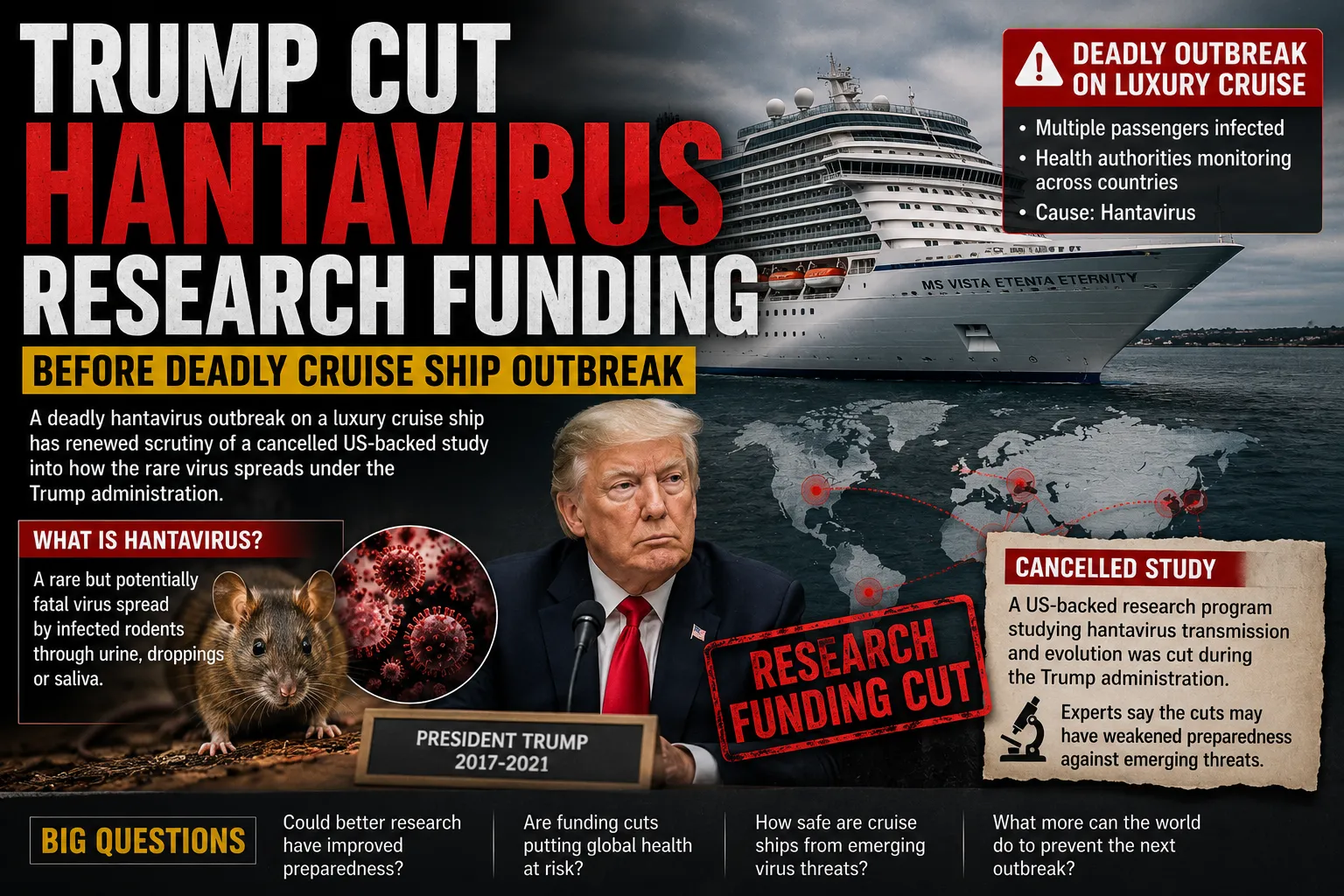
A deadly hantavirus outbreak aboard a luxury cruise ship has triggered renewed global concern over pandemic preparedness, infectious disease surveillance, and the long-term consequences of scientific funding cuts made during the Trump administration. As health agencies across multiple countries continue monitoring passengers exposed to the rare virus, attention has shifted toward a cancelled US-backed research programme that had reportedly focused on studying the same hantavirus strain now linked to the outbreak.
The controversy has reignited debates over whether reductions in infectious disease research funding may have weakened global understanding of emerging viral threats. Public health experts, epidemiologists, and scientists are now questioning whether earlier investment in hantavirus research could have improved preparedness, detection systems, and outbreak response capabilities before the cruise ship emergency unfolded.
The outbreak itself has become one of the most alarming international health incidents of recent months because hantavirus infections remain relatively rare but potentially deadly. The situation has also exposed broader concerns about disease transmission in confined travel environments such as cruise ships, which have faced increasing scrutiny since the COVID-19 pandemic highlighted the vulnerability of large passenger vessels to infectious outbreaks.
What Is Hantavirus?
Hantavirus refers to a family of viruses primarily spread through contact with infected rodents, especially through exposure to rodent urine, droppings, or saliva. Humans can become infected by inhaling contaminated particles in enclosed spaces or through direct contact with infected materials.
Different hantavirus strains exist across various regions of the world, with some causing severe respiratory illness known as Hantavirus Pulmonary Syndrome (HPS), while others can trigger kidney-related complications.
Although relatively rare compared to many other infectious diseases, hantavirus infections can be extremely dangerous because symptoms often escalate rapidly after the initial illness phase. Common early symptoms include:
-
Fever
-
Fatigue
-
Muscle pain
-
Headaches
-
Chills
-
Nausea
As the infection progresses, patients may develop serious respiratory complications, fluid buildup in the lungs, and severe breathing difficulties. In serious cases, mortality rates can become significantly high if treatment is delayed.
Because no universally approved antiviral cure currently exists for most hantavirus strains, early diagnosis and supportive medical care remain critically important.
The Cruise Ship Outbreak That Sparked Global Concern
The current controversy intensified after health officials confirmed multiple hantavirus infections linked to passengers aboard a luxury cruise ship operating international routes. Several passengers reportedly developed symptoms during or shortly after the voyage, leading authorities to launch urgent contact tracing and health monitoring efforts across multiple countries.
The confined environment of cruise ships naturally raises concern during infectious outbreaks because passengers share dining areas, cabins, recreational spaces, ventilation systems, and close social interaction for extended periods.
Health authorities are reportedly investigating possible exposure sources connected to contaminated areas or environmental conditions aboard the vessel. While hantavirus is not generally considered highly contagious through person-to-person transmission in most strains, public health officials remain cautious because enclosed travel environments can complicate disease containment efforts.
The outbreak quickly attracted international media attention because cruise ships remain strongly associated with public health vulnerability following the global COVID-19 crisis.
Passengers exposed to the virus are now reportedly being monitored for symptoms while health agencies continue assessing potential transmission risks and environmental contamination factors.
The Cancelled Research Programme Now Under Scrutiny
The outbreak has renewed attention toward a previously cancelled US-backed hantavirus research initiative that reportedly aimed to better understand how certain rare hantavirus strains spread and evolve.
According to reports, the programme lost federal support during broader funding reductions affecting several infectious disease and global health research projects under the Trump administration. Critics now argue that the cancellation may have slowed scientific progress in understanding emerging zoonotic threats.
Researchers involved in infectious disease surveillance have long warned that rare viruses with pandemic potential require sustained long-term investment even when immediate outbreaks are not occurring. Scientific studies focused on viral evolution, environmental transmission, wildlife monitoring, and outbreak modelling are often considered essential for future preparedness.
The renewed debate does not necessarily claim the cancelled research would have prevented the current outbreak entirely. However, some public health experts believe stronger research infrastructure might have improved scientific understanding, diagnostic readiness, or early-warning capabilities regarding hantavirus behaviour and transmission patterns.
The controversy has therefore become part of a larger discussion about how governments prioritise public health research funding.
Why Infectious Disease Funding Matters
The hantavirus debate highlights the broader importance of consistent investment in infectious disease research, even for viruses that appear relatively rare at a given moment.
Public health experts frequently warn that emerging pathogens often receive attention only after outbreaks occur. Once immediate crises fade, funding for surveillance and scientific study sometimes declines until another emergency emerges.
Modern infectious disease research supports several critical areas including:
-
Virus detection systems
-
Wildlife surveillance
-
Vaccine development
-
Diagnostic tools
-
Transmission modelling
-
Public health preparedness
-
Environmental monitoring
-
Outbreak forecasting
Global health specialists argue that early scientific investment can significantly improve response times during future emergencies. Even when research does not produce immediate solutions, the data collected can help governments and medical systems respond more effectively once outbreaks appear.
The COVID-19 pandemic dramatically reinforced the importance of preparedness infrastructure, global cooperation, and sustained scientific funding.
The current hantavirus controversy is now being viewed through that same lens.
Cruise Ships and Public Health Risks
The outbreak has also revived concerns regarding public health management aboard cruise ships. Large passenger vessels create unique conditions that can accelerate disease exposure due to dense populations living in confined environments for extended periods.
Modern cruise ships function almost like floating cities, containing:
-
Restaurants
-
Entertainment venues
-
Shared recreational areas
-
Medical facilities
-
Air circulation systems
-
Thousands of passengers and crew members
These conditions can complicate outbreak control efforts, especially when passengers travel internationally and disembark across multiple countries.
Since the COVID-19 era, cruise operators have introduced stricter sanitation protocols, health screening systems, and onboard medical procedures. However, experts note that emerging infectious diseases continue to pose risks because global travel inherently increases opportunities for cross-border disease exposure.
The hantavirus incident demonstrates that even rare viruses can create international health concerns when linked to major travel networks.
Political Debate Over Trump-Era Health Policies
The renewed scrutiny surrounding the cancelled research programme has inevitably triggered political debate in the United States. Critics of the Trump administration argue that reductions in scientific and global health funding weakened long-term preparedness against emerging infectious threats.
During Trump’s presidency, several proposed budget plans included cuts to research agencies, international health programmes, and pandemic preparedness initiatives. Supporters of the administration, however, argued that broader government spending reductions were necessary and that agencies should prioritise efficiency.
The hantavirus controversy has now become part of a recurring debate about how governments balance economic priorities with long-term public health investment.
Many scientists stress that infectious disease preparedness often appears expensive before a crisis occurs but becomes invaluable once outbreaks emerge. Public health systems typically require years of research, infrastructure building, and international cooperation to respond effectively during emergencies.
The current situation has therefore reignited discussions about whether global governments are adequately prepared for future biological threats.
Challenges in Detecting Rare Viruses
One reason hantavirus outbreaks can become especially dangerous is that the disease is relatively unfamiliar to many healthcare systems and physicians compared to more common respiratory illnesses.
Early symptoms often resemble flu-like infections, which can delay diagnosis during initial stages. In rare diseases, delayed recognition can increase complications because patients may not receive specialised supportive treatment quickly enough.
Additionally, rare viruses sometimes receive less research attention due to limited case numbers, making diagnostic tools, treatment protocols, and epidemiological data less developed.
This is why many infectious disease experts advocate maintaining research investment even in lower-profile pathogens. Viral ecosystems constantly evolve, and zoonotic diseases originating from animals continue to represent one of the largest long-term risks to global health security.
Scientists warn that climate change, urban expansion, environmental disruption, and global travel may increase human exposure to previously isolated pathogens in coming decades.
The Growing Importance of Global Disease Surveillance
The cruise ship outbreak also demonstrates how interconnected modern public health systems have become. A localized infection event can rapidly evolve into an international monitoring operation because passengers travel across borders within hours.
Global disease surveillance networks now play a central role in identifying outbreaks, sharing medical data, coordinating response strategies, and tracking exposure chains. International cooperation between governments, laboratories, and public health agencies has become increasingly essential in managing emerging diseases.
Experts believe future outbreak preparedness will depend heavily on stronger global coordination, rapid information sharing, and continuous scientific collaboration.
The hantavirus situation highlights how even relatively rare pathogens can quickly gain international relevance in today’s highly connected world.
Final Thoughts
The deadly hantavirus outbreak aboard a luxury cruise ship has evolved into more than just a public health emergency. It has reopened larger discussions about infectious disease preparedness, scientific funding priorities, pandemic prevention, and the long-term consequences of reducing research investment in emerging pathogens.
While it remains unclear whether the cancelled US-backed hantavirus research programme would have directly changed the outcome of the current outbreak, the controversy underscores the growing importance of sustained scientific infrastructure in an era of increasingly complex global health risks.
The situation also serves as another reminder that rare diseases cannot be ignored simply because outbreaks are infrequent. In a world defined by rapid international travel, environmental change, and expanding human-animal interaction, even lesser-known viruses can quickly become serious international concerns.
As health agencies continue monitoring exposed passengers and investigating the outbreak’s origins, the debate surrounding research funding and global preparedness is likely to remain a major topic in both scientific and political discussions for months ahead.
newstapy.com newstapy.com newstapy.com newstapy.com newstapy.com newstapy.com newstapy.com newstapy.com newstapy.com newstapy.com newstapy.com newstapy.com newstapy.com newstapy.com newstapy.com newstapy.com newstapy.com newstapy.com newstapy.com newstapy.com newstapy.com newstapy.com newstapy.com newstapy.com newstapy.com newstapy.com newstapy.com newstapy.com newstapy.com newstapy.com newstapy.com newstapy.com newstapy.com newstapy.com newstapy.com newstapy.com newstapy.com newstapy.com newstapy.com newstapy.com newstapy.com newstapy.com newstapy.com newstapy.com newstapy.com newstapy.com newstapy.com newstapy.com newstapy.com newstapy.com newstapy.com newstapy.com newstapy.com newstapy.com newstapy.com newstapy.com newstapy.com newstapy.com newstapy.com newstapy.com newstapy.com newstapy.com newstapy.com newstapy.com newstapy.com newstapy.com newstapy.com newstapy.com newstapy.com newstapy.com newstapy.com newstapy.com newstapy.com newstapy.com newstapy.com newstapy.com newstapy.com newstapy.com newstapy.com newstapy.com newstapy.com newstapy.com newstapy.com newstapy.com newstapy.com newstapy.com newstapy.com newstapy.com newstapy.com newstapy.com newstapy.com newstapy.com newstapy.com newstapy.com newstapy.com newstapy.com newstapy.com newstapy.com newstapy.com newstapy.com newstapy.com newstapy.com newstapy.com newstapy.com newstapy.com newstapy.com newstapy.com newstapy.com newstapy.com newstapy.com newstapy.com newstapy.com newstapy.com newstapy.com newstapy.com newstapy.com newstapy.com newstapy.com newstapy.com newstapy.com newstapy.com newstapy.com newstapy.com newstapy.com newstapy.com newstapy.com newstapy.com newstapy.com newstapy.com newstapy.com newstapy.com newstapy.com newstapy.com newstapy.com newstapy.com newstapy.com newstapy.com newstapy.com newstapy.com newstapy.com newstapy.com newstapy.com newstapy.com newstapy.com newstapy.com newstapy.com newstapy.com newstapy.com newstapy.com newstapy.com newstapy.com newstapy.com newstapy.com newstapy.com newstapy.com newstapy.com newstapy.com newstapy.com newstapy.com newstapy.com newstapy.com newstapy.com newstapy.com newstapy.com newstapy.com newstapy.com newstapy.com